Episode 8: Plato and the Founding Bet: How a Mocking Label Became a Discipline
What does it cost to found an institution on the claim that genuine knowledge belongs only to the few?
Episode 8 asks what it took to make that transformation happen — and what it cost. Three themes are introduced in the episode. First: how Plato executed a double move, linguistic and substantive, recasting the term philosophos across four of his dialogues and then claiming it as the only practice genuinely capable of guiding a human being toward virtue, knowledge, and flourishing.[2] Second: what kind of claim about knowledge — specifically the distinction between episteme (knowledge) and doxa (opinion) — that defense required. Third: what the founding bet sacrificed — when Plato restricted philosophia to a small group of the specially trained, he was, per Prof. W.K.C. Guthrie's historical account[3] and Prof. George Klosko's reading,[4] abandoning the egalitarianism of Socrates in favor of something that would define Western intellectual life for centuries.
Episode 8 is the opening episode of the Academy Arc — a three-episode sequence tracing Plato's institutional response to the collapse of the Sophist educational program. Episodes 5 through 7 established the terrain: the Sophists' horizontal theory of cumulative progress through teachable excellence, and — in Episode 7's account of Callicles — the political endpoint to which that theory could lead when applied by a man of raw ambition unconstrained by philosophy. Callicles is not Plato's caricature of a bad student; he is, as Prof. Klosko argues, what the Sophist program produces when it works. Episode 8 asks what Plato built in response.
The episode's primary scholarly anchor is Moore's Calling Philosophers Names, which reconstructs the etymology, social history, and philosophical transformation of the word philosophos across the fifth and fourth centuries BCE. Moore's argument drives the episode's first two moves: the rescue of the term from mockery, and the substantive claim Plato attached to the rescued word. Guthrie's historical account of the early Academy situates the institutional stakes. Klosko's analysis of Plato's political development and Prof. Julia Annas's reading of the Republic's democratic cost anchor the third move. The episode's core claim is that Plato's founding of the Academy was simultaneously a linguistic act, an epistemological argument, and a political wager — and that the wager has not been fully settled.
Key Moment 1 — The Word Itself: From Mockery to Discipline
Moore's argument begins with a social observation: before Plato, philosophos was not a title anyone would have chosen for themselves. It carried the connotation of the person who was too clever by half — someone who aspired toward the circle of the sophoi, the genuinely wise, without having earned membership.[5] Moore traces a pattern familiar from other social histories: the norm-policing label that is appropriated by its targets and turned into the name of a practice. What "Quaker" became for a dissenting religious community, philosophos became — through Plato's deliberate terminological campaign — for a new kind of intellectual institution. Moore shows this campaign unfolding across the Phaedrus, the Lysis, the Symposium, and the Republic: four dialogues in which the word's meaning is progressively narrowed, dignified, and attached to a specific and demanding practice.[6] The consequence Moore draws explicitly is one the episode surfaces for the listener: each time a philosophy instructor opens a course today by defining philosophy as "the love of wisdom," they are implicitly vindicating a fourth-century BCE linguistic move.
Key Moment 2 — The 399 BCE Moment: Death, Language, and Institution
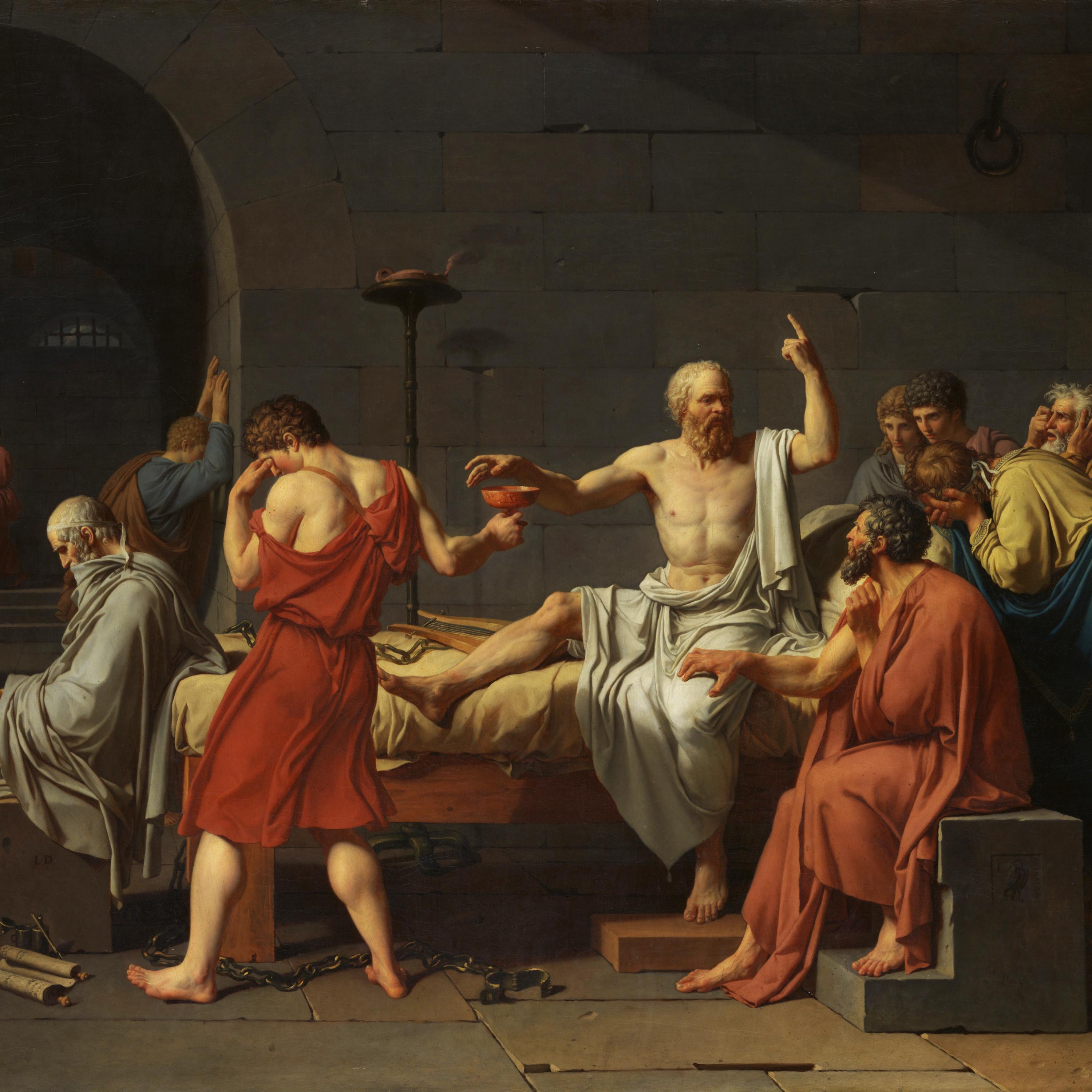
Moore identifies a striking sequence: Socrates's execution in 399 BCE coincides with what he calls a linguistic explosion of the term philosophos.[7] The word multiplies rapidly in the years immediately following the trial. Moore's reading is not that Plato founded the Academy simply out of grief — the motivations are more complex — but that Socrates's death created both the necessity and the opportunity for institutionalization. The practice Socrates had embodied, improvised, and conducted without institutional shelter had been shown to be vulnerable: a city had killed its most rigorous questioner, and the method had died with the man. What the Academy built was a structure designed to outlast any individual practitioner — a community of inquiry capable of transmitting its method across generations. The episode holds this reading as my own curatorial observation drawn from Moore's account, not a settled biographical claim.
Key Moment 3 — The Democratic Cost: Episteme, Doxa, and the Founding Exclusion
The Academy's founding claim — that genuine knowledge, episteme, is categorically different from opinion, doxa, and achievable only through sustained philosophical training — carried a political consequence that Prof. Klosko and Prof. Annas each trace, though they emphasize different dimensions of it. Klosko shows that Plato's move required abandoning the Socratic egalitarianism of the early dialogues: where Socrates had proceeded on the assumption that all citizens possessed rational capacity, Plato's Republic insists that only the highly gifted few can glimpse the Forms, and that the city must be ordered accordingly.[8] Annas approaches the same problem from the direction of compulsion: most people end up subjected to demands — a vision of the good — that they would not recognize as their own and did not choose.[9] These are not identical positions. Klosko focuses on the political structure that exclusivism produces; Annas on the psychological cost it requires. The episode does not resolve the tension between them. It holds both readings open as the question the Academy's founding bet was designed to answer — and may not have been answered satisfactorily.
Connecting the Dots
Episode 8 is the hinge on which the series' central argument turns. Episodes 5 through 7 established what the Sophists built and where it led: a horizontal theory of cumulative progress in which teachable excellence — technē — spreads outward across citizens, making the city progressively more capable. Episode 7's account of Callicles revealed the political endpoint of that theory when applied without moral constraint. The question Episode 8 inherits is what Plato substituted for the Sophist model — and the answer begins, as Moore argues, not with a school but with a word.
The move Moore reconstructs is double: linguistic first, then substantive. Plato first had to rescue the name of what the Academy would do — and that rescue required a deliberate campaign across four dialogues before the institution could make its claim. That claim, once established, rested on the episteme/doxa distinction: the argument that genuine knowledge is categorically different from opinion and that only the philosophically trained can attain it. Prof. Guthrie's historical account situates what was unprecedented about that claim in the ancient world: no institution had previously staked its existence on the proposition that philosophical knowledge could accumulate across generations — that the next cohort could begin where the last left off.[10]
Episodes 9 and 10 build from here. Episode 9 examines the Academy's mechanics — how the institution actually worked, what its pedagogy involved, and what succession problem Plato may not have solved before his death. Episode 10 returns to the founding bet in the light of its first serious test. Moore identifies Aristotle's departure from the Academy as the moment that test arrives: his expansion of philosophical inquiry to encompass all prior thinkers, not only immediate interlocutors, is a different wager from Plato's.[11] What happens when the first graduate of the founding institution decides to do something different is the question the arc closes on.
Connection to Notions of Progress
The founding of the Academy is a progress claim — but a particular and restricted one. Applying Prof. Tyson Retz's framework curatorially: where the Sophists built a horizontal model of cumulative progress — skill spreading outward across citizens simultaneously — Plato's Academy built something vertical: knowledge accumulating upward through a trained lineage, generation by generation.[12] Notions of Progress traces how human beings have understood their own capacity for advancement, and the Academy's founding bet is one of the most consequential early answers to that question in Western history. This episode surfaces the scholarly debate about what that bet cost — through Klosko's account of structural exclusion and Annas's account of psychological imposition — without prescribing which reading is correct. That is the listener's question to hold.
For Further Reading
Primary Sources
Plato. Meno, 87c–100b. The concluding argument in which Socrates arrives at the conclusion that virtue cannot be systematically taught and arrives by something closer to divine dispensation. Read before the Gorgias to feel the full weight of what the Sophist program is being measured against. Cooper–Hackett translation recommended.
Plato. Phaedrus. One of the four dialogues Moore identifies as sites of Plato's terminological campaign to recast philosophos as "lover of wisdom." The soul's orientation toward wisdom and the distinction between genuine and imitative rhetoric are the relevant sections. Cooper–Hackett translation.
Plato. Gorgias, 447a–527e. The dialogue that closes Episode 7's argument and provides the dramatic context for Episode 8's founding question. The Callicles exchange (481b–527e) establishes what Plato is arguing against; the epistemological claims underlying the Academy are the answer. Cooper–Hackett translation.
Further Context
Moore, Christopher. Calling Philosophers Names: On the Origin of a Discipline. Princeton University Press, 2020. The primary scholarly anchor for Episode 8. Moore reconstructs the etymology and social history of philosophos across pre-Platonic and Platonic sources, showing that Plato's terminological decisions encoded a philosophical and political program. Ch. 1 (the mocking origins of the word) and Ch. 8 (the four-dialogue campaign to recast it) are the essential chapters.
Guthrie, W.K.C. A History of Greek Philosophy, Vol. IV. Cambridge University Press, 1975, pp. 19–40. Guthrie's historical account of the early Academy situates the institutional stakes of the founding bet. His treatment is more measured than Moore's on questions of motivation, and reading both together gives the full range of scholarly interpretation.
Klosko, George. The Development of Plato's Political Theory. Methuen, 1986, pp. 83–85; 135–136. Klosko traces the shift from Socratic egalitarianism to Platonic exclusivism across the dialogues. His account of the episteme/doxa distinction and the democratic cost of the Academy's founding claim is the episode's anchor for Key Moment 3.
Annas, Julia. An Introduction to Plato's Republic. Oxford University Press, 1981, pp. 181, 229, 287. Annas approaches the Academy's founding cost from the direction of compulsion: most people end up living under a vision of the good they would not recognize as their own. Her account is the scholarly counterweight to Klosko's structural reading and the grounding for the episode's open question.
Retz, Tyson. Progress and the Scale of History. Cambridge University Press, 2022. The series anchor. Retz's framework — applied here as a curatorial lens, not attributed as Retz's own claim about Plato — provides the vocabulary for distinguishing the Sophists' horizontal model of cumulative progress from the Academy's vertical alternative. See Episodes 3–4 for the full framework.
Question 1
What does it mean that the discipline's most basic self-description is itself a historical construction — a term of mockery that was appropriated, redefined, and institutionalized?
Question 2
Prof. Klosko shows that Plato abandoned Socratic egalitarianism — the assumption that all citizens possess rational capacity — in favor of a model in which only the highly gifted few can glimpse the Forms.[13] Is that abandonment a betrayal of Socrates, or the intellectually honest consequence of following Socrates's method to its conclusion?
Question 3
Prof. Annas argues that Plato's Republic ends by imposing on most people demands they would not recognize as their own.[14] If a theory of progress requires that most people be governed by those who know better — subjected, as Klosko puts it, to conditioning they did not choose — does that theory deserve the name "progress"? Or does the Academy's founding bet describe something that requires a different word entirely?
Related Episodes
Episode 5: The Sophists — Human Agency, Technē, and the First Theory of Civic Progress. Establishes the Sophist framework and the horizontal model of cumulative progress that Episode 8 rejects.
Episode 6: Plato vs. the Sophists, Part 1 — The Cave, Recollection, and the Case Against Cumulative Knowledge. The first two pillars of Plato's counter-argument.
Episode 7: Plato vs. the Sophists, Part 2 — Rhetoric, Power, and the Making of Callicles. The direct bridge to Episode 8.
Episodes 3–4: Five Faces of Progress — Prof. Tyson Retz. The taxonomic framework applied across the series.
Footnotes
1 Moore, Christopher. Calling Philosophers Names: On the Origin of a Discipline. Princeton University Press, 2020, Ch. 1, pp. 1–2.
2 Moore, Christopher. Calling Philosophers Names. Princeton University Press, 2020, Ch. 8, pp. 221–259.
3 Guthrie, W.K.C. A History of Greek Philosophy, Vol. IV. Cambridge University Press, 1975, pp. 19–40.
4 Klosko, George. The Development of Plato's Political Theory. Methuen, 1986, pp. 135–136.
5 Moore, Christopher. Calling Philosophers Names: On the Origin of a Discipline. Princeton University Press, 2020, Ch. 1, pp. 1–2.
6 Moore, Christopher. Calling Philosophers Names. Princeton University Press, 2020, Ch. 8, pp. 221–259.
7 Moore, Christopher. Calling Philosophers Names. Princeton University Press, 2020, Ch. 6, p. 157.
8 Klosko, George. The Development of Plato's Political Theory. Methuen, 1986, pp. 135–136.
9 Annas, Julia. An Introduction to Plato's Republic. Oxford University Press, 1981, pp. 181, 229, 287.
10 Guthrie, W.K.C. A History of Greek Philosophy, Vol. IV. Cambridge University Press, 1975, pp. 19–40.
11 Moore, Christopher. Calling Philosophers Names. Princeton University Press, 2020, Ch. 9, pp. 260–287.
12 Retz, Tyson. Progress and the Scale of History. Cambridge University Press, 2022, p. 15.
13 Klosko, George. The Development of Plato's Political Theory. Methuen, 1986, pp. 135–136.
14 Annas, Julia. An Introduction to Plato's Republic. Oxford University Press, 1981, pp. 181, 229, 287.
[1]Moore, Christopher. Calling Philosophers Names: On the Origin of a Discipline. Princeton University Press, 2020, Ch. 1, pp. 1–2.
[2]Moore, Christopher. Calling Philosophers Names. Princeton University Press, 2020, Ch. 8, pp. 221–259.
[3]Guthrie, W.K.C. A History of Greek Philosophy, Vol. IV. Cambridge University Press, 1975, pp. 19–40.
[4]Klosko, George. The Development of Plato's Political Theory. Methuen, 1986, pp. 135–136.
[5]Moore, Christopher. Calling Philosophers Names: On the Origin of a Discipline. Princeton University Press, 2020, Ch. 1, pp. 1–2.
[6]Moore, Christopher. Calling Philosophers Names. Princeton University Press, 2020, Ch. 8, pp. 221–259.
[7]Moore, Christopher. Calling Philosophers Names. Princeton University Press, 2020, Ch. 6, p. 157.
[8]Klosko, George. The Development of Plato's Political Theory. Methuen, 1986, pp. 135–136.
[9]Annas, Julia. An Introduction to Plato's Republic. Oxford University Press, 1981, pp. 181, 229, 287.
[10]Guthrie, W.K.C. A History of Greek Philosophy, Vol. IV. Cambridge University Press, 1975, pp. 19–40.
[11]Moore, Christopher. Calling Philosophers Names. Princeton University Press, 2020, Ch. 9, pp. 260–287.
[12]Retz, Tyson. Progress and the Scale of History. Cambridge University Press, 2022, p. 15.
[13]Klosko, George. The Development of Plato's Political Theory. Methuen, 1986, pp. 135–136.
[14]Annas, Julia. An Introduction to Plato's Republic. Oxford University Press, 1981, pp. 181, 229, 287.

Episode 7: Plato vs. the Sophists: Rhetoric, Power, and the Making of Callicles