Interview with Matt Ehret - Plato vs. Aristotle: The Flame, the Vessel, and the Fate of Human Progress
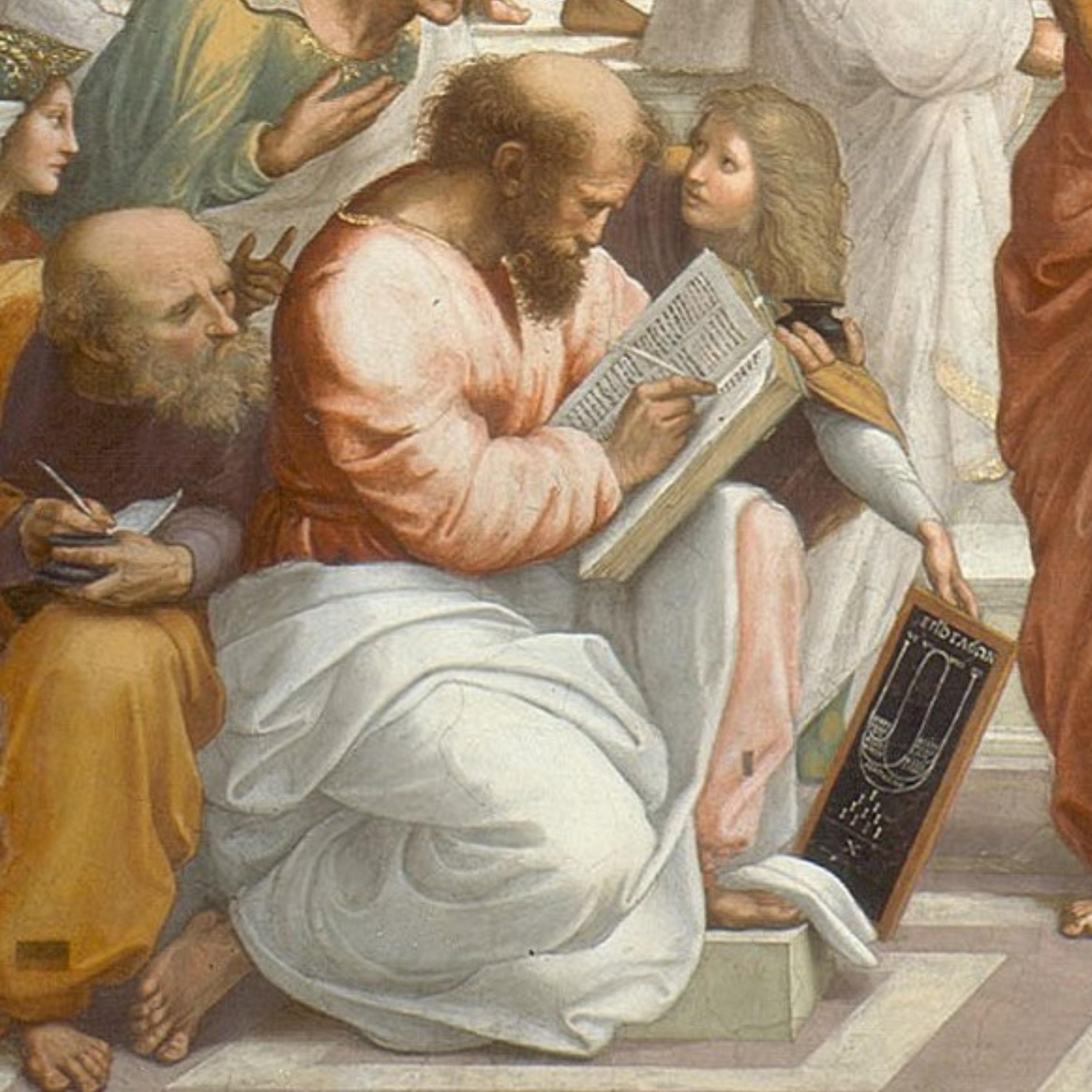


Matt Ehret argues that the divide between Plato and Aristotle is not a historical curiosity confined to the ancient world — it is a living fault line that continues to shape how civilizations understand learning, discovery, and human advancement. In this first of three episodes with Ehret, he makes the case that the Platonic method — learning as recollection, knowledge as something awakened from within rather than deposited from outside — is the engine of genuine human progress. The Aristotelian method, which begins with closed axioms and fills the student as a vessel from without, produces in his reading increasingly sophisticated illusions of progress: the appearance of accumulation without the substance of discovery.
Ehret grounds this argument in the founding conditions of Plato's Academy — its geometry requirement, its Pythagorean foundations through Archytas of Tarentum, and its core pedagogical premise that a student must construct knowledge rather than receive it. The Meno dialogue serves as the episode's central demonstration: Socrates leads an uneducated slave boy to geometric truth not by instruction but by guided questioning, showing that genuine understanding is always an act of recollection, not reception. The episode closes on its first Plato–Aristotle contrast: a verb-driven universe against a noun-driven one — and leaves open the question of which tradition the West has actually been running on.
This is Part 1 of a three-episode arc with Ehret tracing the Plato–Aristotle divide and its consequences for Western intellectual history.
Show Notes & Timestamps00:00 — Introduction to Progress and Ideas
00:29 — Welcome to Notions of Progress
02:24 — Introducing Matt Ehret
03:27 — Today’s Focus: Ideas as Operating Systems
07:51 — The Platonic Method: Learning as Discovery
12:45 — The Academy: Plato’s Educational Innovations
15:16 — The Meno Dialogue: Virtue and Knowledge
21:05 — Sophistry vs. Philosophy: The Battle for Wisdom
35:58 — The Allegory of the Cave
Key Concepts & TermsConstructive GeometryThe method of geometric reasoning that Plato required of all Academy students — and that Ehret identifies as the epistemological foundation of the Platonic tradition. In constructive geometry, the student begins with no axioms and no assumptions. Instead of being told that a square has four equal sides and right angles, the student is asked to construct one from scratch using only a compass and straightedge, discovering its properties through the process of building it. Nothing is taken on faith; everything must be demonstrated. Ehret contrasts this with the Aristotelian approach, which begins with fixed definitions and proceeds deductively from them. For Plato, geometry taught in the constructive mode was not merely a mathematical exercise — it was training in the discipline of genuine discovery, preparing the mind to approach questions of justice, virtue, and political life without being captured by false reasoning.
Anamnesis (an-am-NEE-sis)The Greek term for recollection, and the name Plato gives to his theory of how genuine knowledge is acquired. Plato argues — most explicitly in the Meno — that the soul already contains knowledge of the eternal truths of mathematics, geometry, and virtue. What we call learning is not the addition of new information to an empty container but the reawakening of what the soul already knows. Ehret uses this concept to draw the sharpest distinction between the Platonic and Aristotelian frameworks: where Aristotle imagines the student as a vessel to be filled, Plato imagines the student as a flame to be lit. The Meno's slave boy demonstration — in which Socrates guides an uneducated boy to geometric truth through questioning alone, without ever stating the answer — is the episode's central illustration of anamnesis in action.
Tabula Rasa (TAB-yoo-la RAH-sa)Latin for 'blank slate.' The concept, closely associated with Aristotelian and later Lockean epistemology, that the human mind at birth contains no innate knowledge — it is an empty surface on which experience writes. Ehret invokes this term to clarify what the Platonic method explicitly rejects. For Plato, knowledge is not inscribed on the mind from outside; it is recollected from within. The pedagogical consequences are profound: a tabula rasa model produces a teacher who transfers information and a student who receives it. A Platonic model produces a teacher who poses questions and a student who makes discoveries. Ehret argues that the history of Western education has largely followed the tabula rasa model — with consequences for how institutions understand progress.
Archytas of Tarentum (ar-KY-tas of ta-REN-tum)The Pythagorean mathematician and statesman (c. 428–347 BCE) whom Ehret identifies as a direct intellectual precursor to Plato's Academy. A close friend of Plato's, Archytas was the first to solve the problem of doubling the cube — finding a cube with exactly twice the volume of a given cube — not through algebraic calculation but through a purely geometrical construction involving a cone, a cylinder, and a sphere. Ehret presents this achievement as the paradigm case of constructive geometric reasoning: a problem that defeated purely mathematical approaches was solved by someone who understood geometry as the investigation of physical reality, not the manipulation of symbols. Archytas's students formed the first generation of Plato's Academy, and his influence is visible in the inscription above the Academy's entrance: Let no one who does not know geometry enter these walls.
Fascinating Historical InsightsThe Inscription Above the Academy's EntranceWhen Plato founded his Academy in Athens around 387 BCE, he placed an inscription above the entrance that read: Let no one who does not know geometry enter these walls. Ehret describes this not as an administrative gatekeeping measure but as a philosophical statement about the kind of mind the Academy was designed to cultivate. Geometry, in the constructive mode Plato required, was the discipline that trained students to make genuine discoveries rather than accept received truths — to discover rather than assume. By the time a student had demonstrated genuine geometric competence, they had already practiced the essential intellectual virtue the Academy demanded: the willingness to suspend assumed knowledge and work toward truth through their own demonstrated reasoning.
Doubling the Cube: A Problem That Required a New Kind of ThinkingOne of antiquity's three great unsolved geometric problems — alongside trisecting an angle and squaring the circle — was the Delian problem: how to construct a cube with exactly double the volume of a given cube. Purely mathematical approaches consistently failed. Archytas of Tarentum solved it around 400 BCE using a three-dimensional geometric construction involving a cone, a cylinder, and a torus — a solution that required imagining the intersection of three surfaces in space. Ehret presents this as the defining example of constructive geometry's power: the problem yielded not to more sophisticated calculation but to a fundamentally different mode of thinking. Plato's friendship with Archytas, and his incorporation of Archytas's students into the Academy's founding cohort, meant that this discovery-oriented, construction-first approach became the Academy's pedagogical foundation.
The Slave Boy Demonstration in the MenoIn Plato's Meno dialogue, Socrates undertakes an unusual demonstration. He calls over an uneducated slave boy — a young man with no formal mathematical training — and, through a sequence of carefully posed questions, guides him to discover the geometric principle for doubling the area of a square. Socrates never states the answer. He poses questions, allows the boy to make wrong assumptions, lets him discover his own errors, and waits for the correct insight to emerge from the boy's own reasoning. At the end, the boy has arrived at a genuine geometric truth — not by being told it, but by finding it himself. Plato's point, as Ehret reads it, is not modest: this demonstration shows that genuine knowledge is always recollection. The capacity for mathematical truth was already latent in an uneducated slave. What Socrates provided was not information but the conditions in which discovery could occur.
A Noun-Driven Universe vs. a Verb-Driven UniverseNear the close of the episode, Ehret introduces the first of the contrasts he will develop across the three-part arc: Plato and Aristotle understood reality itself in fundamentally different terms. For Aristotle, the universe is composed of substances — things with fixed natures, definable by their essential properties. The task of knowledge is to correctly categorize these substances and reason from their definitions. The universe, on this model, is fundamentally noun-shaped. For Plato, reality is dynamic: the eternal forms exert an ongoing influence on the changing world of appearances, and the soul is always in motion toward or away from truth. Knowledge is not the correct labeling of fixed things but an active, ongoing process of recollection and discovery. The universe, on this model, is fundamentally verb-shaped. Ehret argues this distinction carries consequences far beyond ancient philosophy — it shapes how Western civilization has understood learning, progress, and what it means to advance.
Resources & Further ReadingPrimary SourcesPlato. Meno. In Cooper, John M. (ed.), Plato: Complete Works. Hackett, 1997.
Plato. Gorgias. In Cooper, John M. (ed.), Plato: Complete Works. Hackett, 1997.
Works DiscussedEhret, Matthew. The Clash of the Two Americas, Vol. 1. Canadian Patriot Press, 2021.
Ehret, Matthew. The Untold History of Canada series. Canadian Patriot Press, 2019.
Further ContextFor the A...
00:00 - Introduction to Progress and Ideas
00:29 - Welcome to Notions of Progress
02:24 - Introducing Matt Ehret
03:27 - Today's Focus: Ideas as Operating Systems
07:51 - The Platonic Method: Learning as Discovery
12:45 - The Academy: Plato's Educational Innovations
15:16 - The Meno Dialogue: Virtue and Knowledge
21:05 - Sophistry vs. Philosophy: The Battle for Wisdom
35:58 - The Allegory of the Cave
0:00 in Plato's idea as he outlines in so many of his dialogues including the Meno but also the phaedo that that a real discovery is more akin to the quality of a recollection than it is to adding something to an existing uh vessel hi welcome to notions of progress the show that traces ideas of progress from antiquity to the age of AI notions of progress exist to surface how thinkers across history and across disciplines have understood what progress is where it comes from and how it manifests in the world that includes academics and public intellectuals mapping its intellectual history and arguing for the traditions that they believe are still at work in shaping it previous episodes in this series have traced how the idea of progress has been understood debated and contested from antiquity to the present today however we open a different kind of conversation in examining progress in action we engage with thinkers who don't stand outside the debate they're actually inside it arguing that a specific tradition is not merely an idea about progress but its actual engine this series interview guest Matt Ehret's argument is sweeping and direct
1:31 for two and a half thousand years western civilization has been shaped by a battle between two philosophical traditions a platonic conception that holds the human mind capable of genuine creative discovery versus an Aristotelian perspective that in his view systematically forecloses that capacity everything genuinely progressive in human history Ehret argues flows from the first tradition and the central question he raises whether the minds our civilization produces are capable of real discovery or are sophisticated prisoners of their own assumptions is he contends as urgent now as it was in Plato's Athens I hope you find it as rich and thought provoking as I did here's my conversation with Matt Ehret today we are very fortunate to have a very special guest on Today Matt Ehret Matt is a Canadian journalist historian and lecturer and a co founder of Montreal based Rising Tide Foundation he is editor in chief of the Canadian Patriot Review and a senior fellow at the American University in Moscow Matt contributes to a wide variety of publications that both him and his wife Cynthia Chung are frequent guests on a dizzying number of programs his work spans intellectual history geopolitics philosophy history just to name a few disciplines and today's show is gonna be about the platonic versus the Aristotelian divide as civilization fault lines Matt also has a series of books
3:02 to name just a few the Untold History of Canada and four volumes The Clash of the two Americas and most recently Science Unshackled I'm going to put in the show notes all of Matt's work so that you can see it but I think at this point let me just move forward and welcome you Matt thank you so much for coming on it's a great honor and a pleasure to have you on hey thank you Marshall it's always a pleasure chatting with you so I'm looking forward to today's conversation fantastic well today our main focus is to understand how ideas of progress were formed and how they act as an operating system a fundamental way of thinking and a and a system that is carried on through time for those who've watched the last few episodes of the show we've been focusing on ancient Greece we've discussed the Academy we've discussed Plato's ideas in the Academy where he got some of his ideas Socrates Aristotle and I think today we take a short step and and and contextualize this information and understand what these ideas were what the major convergence points were and most importantly how these ideas have carried forward and just as an aside just by virtue of the fact that we are discussing ancient Greece as an idea of progress flies against up till the early 20th century the conventional opinion that progress began during the Enlightenment so just even the idea of progress before is a revolutionary idea in and of itself and with that sorry for the long introduction map but I wanted to make sure that people my listeners got a good sense of kind of where you were coming from thanks man I mean that that that's a really great introduction and I I love what you're doing with this theme
4:34 in this program overall to really help people develop a new relationship and appreciation of those causal ideas that gave rise to everything good about humanity and that have largely been uh the target of a misinformation campaign I would say or an organized intentional misinformation campaign to sever us from a connection of those principle concepts and that way of thinking that has at the best of times brought humanity out of squalor out of darkness and into a better way with a better sense of self dignity a better sense of freedom and a better sense of you as you've said of progress which manifests itself in a myriad of ways that all transcend the limits to our existence that we were otherwise had we been less creative inclined to adapt to as some form of zoo creature in a in a cage happy with whatever the zookeeper gives it as food stuffs inside of that cage but humanity in a more creative more dignified state has been inclined to resist to find that suffocating spiritually and to imagine a better world that is more fit for a society of justice and act accordingly and shape their identities accordingly around that higher set of ideas and whether that manifests in in progress in sciences and technology in the arts in political freedom it's all sort of different species of the same thing in my mind and and yeah to not go to to to end our our investigation of where the origins of that movement are
6:05 at the at the Enlightenment would do such a disservice and destroy our ability to I think properly understand the truth that this actually is something which is eminently examinable investigatable in the ancient times of ancient Roman republican and even earlier especially earlier uh Greek the literature and understanding the fights the personalities not just the theories but both the theories and the personalities of those players who moved humanity in such a such an interesting anomalously powerful direction during that period it's of it's of such a benefit so I love the fact that you're that you're doing this and I'm I'm really looking forward to this conversation what I don't think a lot of people realize is just even the word progress itself is something that's ingrained and whether and there's a lot of qualitative and quantitative understandings of progress it's not a the word that's a catch all the the whole purpose of this show is to get on people like Matt who will come on and share a vision and an understanding of progress from their perspective looking back through history cause first and foremost this show is about a historical reading and understanding the context of this and lastly before I turn this over back over to Matt it's important to also realize that the concept in and of itself that we are moving in some direction in history whether that's progress or regress or no progress is testament to the fact that of 25 years later we're still looking back at some of the folks that Matt's gonna introduce us to today that is astounding to me no and it's an important point that you brought up there because you're right like there's no agreement on what that word means
7:39 there's so many theories of progress and the word itself has become almost scandalous to use in our modern day it used to be taken I mean people took it for granted you know generations ago that progress was a good thing and and there was a general consensus yeah yeah progress means getting better not getting worse things becoming more perfect not less perfect not more imperfect but better in some way and and so today I think people have found themselves in increasingly splintered obfuscated academic exercises exactly that have given these words semantic spin and you know papers academic papers and other things have been published and books have been published making progress seem like a terrible thing because progress according to who you know like any word could be a good a the good the the Commonwealth the the good of the whole becomes almost a bad thing in that word too in this world view as well of relative of absolute relativism because yeah according to whose standard are we using the word good and common good or progress if it's a terrible fascist or somebody who wants to subjugate the who believes in the natural subjugation of the majority for the benefit of a of a small minority then their idea of progress of what you're getting what you're using to gauge better or worse is gonna be perhaps atrocious a terrible terrible thing cause they're gonna be progressing towards their disgusting goal but if we have a a baseline which is more objective and I think such baselines do exist as standards
9:09 then we do have something I think that we can agree on more scientifically though it may not be as as mathematically satisfying for some people who wish to to use to or to have mathematical certainty in in everything that they say that that's not gonna be something we could necessarily expect to but if we assume like for example in our own personal lives that there's certain things that all human beings independent of our culture our opinions on things all find value in we have something to work with and I think one of those things is like okay well regardless if you're born today or a thousand years ago or a million years ago or in Africa or Asia or Europe or whatever you probably will need water you probably will need access to water to avoid the the consequences of the biophysical laws of lack of water the the shutdown of metabolic activity that comes with lack of nutrients of food which you know you don't just want for yourself but you also probably want for your kids the family unit whatever social group you find yourself within you probably value whatever allows for clean healthy substance to provide nourishment shelter warmth to keep you from freezing to death if you live in that part of the world or something that allows for some shade and some so there's certain basic things that are required to meet the laws of life and presumably you wouldn't want to just meet them as thing as you know as scarcity increases over time as as food stuffs are eaten up but you recognize that oh we'd probably want to improve the quality and and means of acquiring
10:41 those things that keep us healthy that keep our loved ones healthy that keep that ensures more security for our kids than the type of security we perhaps didn't have as adults growing up you know so I think everyone could agree in these general starting points and then you could scale it up a little bit and say okay well imagine now these types of invariants apply to all of society that okay how can we make not just water certainty what type of technologies allow for the increase of abundance what types of things allow us to overcome wars which increase usually uncertainty scarcity pain suffering injustice so what there's certain decisions that usually you could call progress if you know people actually have a healthy idea of what a what a normal healthy human being in a human species should kind of be geared towards and thus with that healthy baseline as the doctor I think the the the healthy doctor is not somebody who's just a master in sickness they're they're they're such a master in the in the science of knowing disease because they have a baseline idea of what is healthy first and foremost as their standard let me just narrow just zero in on one one word that you said because actually that that describes the incentive for me doing the show to begin with and that is the zeitgeist and it was a zeitgeist and from my own perspective regarding progress and a sense not a conclusion but a sense that there are many people who don't feel that they're progressing and that they're moving backwards and this is what a question that I thought was very interesting to explore and especially in this particular episode we're gonna talk about ancient Greece and you're gonna see this is the fundamental operating system
12:13 behind many of those ideas getting to that truth that Matt described in that virtue and I think today what I'd like to now cue up Matt is we're gonna talk about two pivotal let's say three pivotal factors can we kind of like start an ancient Greece and just just talk a little bit about the ecosystem of the Academy prior to its existence IE Socrates Plato and Aristotle just a little bit about the context of these what these folks were in and then just talk a little bit about their fertilization at the Academy and then the Lyceum etcetera sure yeah um well I suppose yeah the Academy of Plato was the first such academy that as far as I could tell had ever been produced or generated by the human species in a way that is analogous to the sort of thing that that we've seen in in the in the period of the medieval ages and and especially our current world and it was a very new idea and innovation that that young people could be brought to an institution qualified as Plato said if if uh to enter the to enter his academy to even qualify people had lined up from far and wide because of the reputation of this incredible center of learning you had to really master geometry you had to at least demonstrate some knowledge of geometry and there there was an inscription above the entrance to the academy that said let no one who does not know geometry enter these walls and part of the reason that Plato had in his mind as himself a geometer somebody who had mastered constructive geometry even before he set up the academy and he was friends after all Plato before the Academy he was friends with Archytas
13:43 the great Archytas who discovered the doubling of the cube that nobody had figured out until Archytas was able to crack it and involved this incredible it wasn't a mathematical solution it was entirely a geometrical solution involving a cone a cylinder and a and a sphere to double a cube you know it's very different from doubling the square on a two dimensional plane but so this Archytas was was very good friends with with Plato and and Plato had worked with a number of people had himself contributed to our understanding of of the dodecahedron as the fifth platonic solid that's why they call them the platonic solids because Plato recognized that within the process of doing geometry correctly constructively you start with no axioms there's no Euclidean assumptions you just simply start with a challenge of trying to do a thing you start with a square and you're like well I don't assume that I know a square I I have to construct it from only circular action and then once I've discovered it it's not based upon blind faith but on real discoveries along the way of how do I know that these four vertices are in fact absolutely separated from the ascender point equally and have 90 degree angles at each one and how do I then do the same for a triangle an equilateral triangle or a pentagon which requires an exploration of the golden section to understand the Pentagon and once you do that and explore their relationships you could then begin to not just discover objectively what is true in organizing the fabric of reality which does involve a relationship of these core five solids you know but but you're doing it on the two dimensional domain but you could then build it up and unfold these into cubes
15:15 into tetra tetrahegons icosahedrons dodecahedrons and see okay well what did my mind have to do differently that allowed for the construction and true understanding of what these are and what type of new proportions emerge out of comparing them together you know if I nest them all into a sphere of the same size how do their their their edges change proportional to each other what types of harmonics might emerge you know that might have some audio a correlation that might be either pleasant or dissonant if I listened to the musicality of these proportions on a string so he was a follower in his own words in the for example in the Protagoras dialogue of the Pythagorean tradition and here I'm not referring to the mystical hermetic rebranding of the Pythagorean tradition but I mean the real authentic thing as outlined by Timaeus in the the the actual Pythagorean friend of Plato who survived the many destructive persecutions of the Pythagoreans and had the only sort of I think honest outline of what the doctrine actually was that saw a co development of the visual and audio space times that would be something you could explore together by looking at the ironies and the cracks and that would be real geometry yeah so he understood that as you discover in this type of approach more about the objective world around you you're also simultaneously discovering more about the nature and rules of your own mind being creative cause you're not just being a computer processing information you're hypothesizing you're discovering where a false hypothesis
16:48 that was leading you on is in is untrue because it's not helping you solve the problem of let's say doubling the square as he gets the the slave boy of Mino Mino the slave owner who has a slave child he gets him to discover a challenge that requires the slave child also discover Learned ignorance right discovering that what you thought you know you don't know which is a huge power to be able to get that discipline and once you do that and you do it enough you don't have to master everything but once you have a taste for it then you are qualified as Plato put in his the curriculum for his his academy you are then qualified to use the minds at the mind as a proper tool in an analysis of philosophy of the pursuit of wisdom of of justice of these other deeper questions which have you with without that that rigor that you will have Learned in music and geometry you will not be able to approach it in a in a in a meaningful way that will not have you fall slip and and and get pulled into webs of sophistry of false reasoning when trying to deduce well what is justice what is these other big questions that are so impactful on the political world and the and the laws that we happen to be living in and and the the the just or unjust wars that we may find ourselves participating in as pawns of some other agency that might mean us very ill effect so all that to say that was his academy it was set up largely by the fruits of monies that were acquired by a payment
18:20 I don't know if you're if you have if you went through this in previous episodes but you know he was slow he was I've touched on it a bit and and okay and it's yeah and when you were describing kind of Plato's conception of of how one learns and how one reaches this level of virtue could you explain a little bit about his notion of epistemology for example and how and how the idea of virtue so just so that we can frame that so when we talk a little bit later about some of the competing frameworks we can understand you also mentioned the Meno which is one of his well known dialogues just talk a little bit about how Plato used those dialogues to reveal his pistomology if I and I hope that this conversation we're having encourages people to recognize that they need to read Plato himself because this type of thing is like a nice stimulant but it it is not a substitute for actual knowledge I almost I feel like I could say too much that might deprive people of the ability to make a discovery I don't want to deprive people of of the joy of of making that those types of discoveries on their own by reading Plato and and sort of chewing on the ambiguity that he consciously embeds within his dialogues by design because he's trying to stimulate us into thinking for ourselves and not giving us the type of satisfying closed fixed answers to questions that we often are accustomed to expecting in philosophical treaties like that which we might see from the writings of an Aristotle or many of those philosophers in our modern day who tell us exactly what justice is what to think about virtue and these things Plato doesn't do that which is why a lot of people are a bit uncomfortable at first reading him because because he's not doing that
19:51 and they're like is he toying with me is he toying with me or does he not really know and it's like no he's got some pretty strong ideas of what these things are don't get him wrong even though he has his character Socrates his teacher often say that you know he knows that he doesn't know where's everybody else thinks they know and so he's still in a better place to ask questions and to to help them uh become aware of what they thought they knew that they don't know based on a paradox you know so it's useful but they're like no but he but they're like oh does he is he really ignorant of everything and it's like no he's got strong ideas he's just he he knows that one those ideas are not perfect they're not mathematically certain in in such a way that they couldn't be made better so he's he's got that flexibility and self he's really cultivated as a muscle and he wants other people to learn how to do that too and it's more about the process so about Plato there is not a single dialogue that is that gives you a finished sense of satisfaction thinking okay now I know everything I can know about this topic I was just reading about which is a blessing and a and a and a gift that he's giving us because he's giving us tools around which we can analyze anything and everything we wish to at all times and that is universally applicable to anybody from any culture who uses this method it's not it's not an ideology it's not an opinion it's not even temporal it'll be as applicable a thousand years ago as it was 2,500 years ago when he was first writing them and it was equally true before he was writing them this was already a method he just found a way to a dialectic method of of of communication that made it something more transmissible
21:23 transgenerationally in a self conscious manner it's something that I think children even organically do by being humble naturally so you know they have no artificial abstractions or constructs in their mind that are holding their creativity and their flow back so when they're learning to walk or make or speak or or do anything they're they're they're trying things out they're very self you know they're they're they they they they stumble they fall they try again they're courageous because they try again they're uh they're again humble they don't think they know things so they they learn quickly you know that bell curve is fast and I think a lot of that has to do with a natural platonic what we call platonic modality you know what you I just wanna go back to something you said just before you cause you're talking about the method and then you brought up geometry just talk a little bit about how Plato saw mathematics as part of this formation this this kind of formative training if if you will it's yeah in other words you didn't just bring this up randomly I'm guessing you you brought this up within the context of a platonic method if you will yeah well that's right and and you know Plato's school was largely the merger of a a pre existing earlier school of Archytas and one of Archytas's students um whose name is all of a sudden escaping me it's it's uh it'll come later on probably um who was organizing with Plato in the 3 80s uh in Egypt and uh and they went together to with to meet Archytas in uh in in near Syracuse where they made their first attempt to uh to actually create a philosopher king to actually create a movement or to be a part of an existent movement that they wish to direct and amplify
22:54 in a geopolitical fight against a certain force that was controlling at that time the Persian Empire a major nemesis of of of the Greeks and as well as of of the Egypt the better of the Egyptians um so the the the the students of these of the of these schools of Archytas basically worked with Plato who developed his own students as well these are these are Pythagoreans basically and and they formed the the foundation of the first generation of his of his academy and again Archytas was a mathematician of his day part of when you're looking at constructive geometry is it's it's it's what distinguishes it from the bad way of communicating geometric concepts or mathematical concepts is that it's based on a firm understanding that the mathematical language which is relatively symbolic a little bit more arbitrary in terms of which symbols do you choose to represent numbers or you know multiplication symbols or whatever but that it's a symbolic much you know language of math that is much that that must always follow in the dance between physical geometry physics which geometry is understood to be a shadow of mapping of the physical geometry shaping the reality we live in you know you look at a bubble and a bubble takes on a certain characteristic very very similar to a sphere right and and you know as they say the the bubble's pop the sphere is eternal so we we can map as an object an an intellectual object a sphere of which in the physical world there will never be a bubble that is so perfectly spherical
24:25 that in a more perfect one cannot be imagined or formed it's always we're in that type of imperfect world but with the the these these archaic typical transcendental imprints shaping the constructs of for example a atomic formation in minerals which we find these beautiful patterns in silicates and other things of of of geometries that that indicates something very very ordered on the small not chaotic not random on the small that that expresses itself you know certain symmetries in the growth of of the golden section in flowers and in in living populations that we find everywhere where life is is expressing an influence over matter there is the golden section in a way that we don't find in non living atomic arrangements or molecular arrangements it's just not we don't find the golden section so much present in the non living domain so these are all questions that fivefold symmetry that comes with the Pentagon that comes with the an investigation of the golden section right you find the that fivefold symmetry in living things predominantly flowers and other and we find it more as we scale up in our exploration of of the solar system so Plato understood that again real geometry is based upon a pursuit of those eternal principles that shape the the reality that our minds were created into and that we can in turn influence by understanding what they are if we're ignorant they influence us and we have no no our free will has no agency in influencing any of those things outside of us in a in a meaningful way if we remain in a state of ignorance
25:56 but there's as we develop knowledge through eurekas through discoveries that are genuine not memorized those forces are awakened within us because in Plato's idea as he outlines in so many of his dialogues including the Meno but also the phaedo that that a real discovery is more akin to the quality of a recollection than it is to adding something to an existent vessel so yeah like in the Aristotelian framework for example there's more of an idea that learning is adding things to a vessel you're putting things into a student or you're writing on a tabula rasa you're putting things into it's not like that in any way for a teacher using the platonic method or Plato or his teacher Socrates for them it's your your your presuming that everything already is there in a in a latent way within the student the entire universe and all of creation is imprinted on the soul it's kind of like a fractal of that student and that it requires simply to be awoken like a flame you're lighting a flame from within by posing questions in a certain way and giving the space for the student to make mistakes to be frustrated to not try to overly satisfy that frustration prematurely by giving them an answer too quick before it's it's ripe you know you don't want to pluck a fruit before it's ripe so that takes a lot of discernment that's not easy for a teacher to withhold cause it's satisfying to see a kid making this discovery and sometimes a you know a parent who wants their kid to to drive a bike super badly might push their kid too much and the kid will fall off and become afraid of the bike or feel resentment towards the father or the mother
27:26 so you know a good parent is the one who's who's not gonna overly impose you know and it's gonna create that space so all that to say in the in the platonic idea of geometry you're always thinking about okay how do I pose the questions so that the paradox of what they think that they like so what does the Mino do the slave boy do in the Mino dialogue he's got the challenge of doubling the area of a square and it seems simple enough on the surface and he says ah it's easy I mean you just extend the sides by double of the square so he takes a square and he's like okay double a side now that works for a line for the one dimensional domain but for the two dimensional domain that he quickly discovers that he didn't double it he quadrupled it so he actually take the area the area is four times not two times what he thought it was supposed to be so I was like I made a square but it's now four not two times what I wanted so I have to try again and uh and he tries something else and uh and it turns out that that doesn't work and he try you know tries two or three things that doesn't work and then finally by becoming self aware of what he thought he knew he doesn't know now all of a sudden the the discovery that it's actually and I'm I'm not even gonna say what it is cause I I don't wanna steal the discovery from your audience but it flashes like a light and he you know and he he actually discovers the the the solution to the problem and around that the master of the slave boy whose name is Mino who's actually a very shitty character in real in real life he's he's actually the saboteur of of one of the most important strategic military campaigns
28:56 that Plato had participated in with Xenophon against Persia with the 10,000 that figure Meno as a real man in the real world was the guy who betrayed the 10,000 to the Persian emperor and uh caused all of their generals to fall into a trap get killed and then forced Xenophon to take responsibility a friend of Plato to get the 10,000 out of deep deep Persian territory which thank god he was successful but that Mino character was a very very influential oligarchist and he was himself in that dialogue less creative than his own slave the person he owned the child he owned as a slave he didn't want the original challenge was to was posed to him and Plato demonstrated that the person who like a minor personality type who believes in slavery and these things they will be less creative than even a slave and that was I think one of the best demonstrations that gave rise to a a a potent anti slave movement which even Aristotle later on decades and decades later had to deal with because Aristotle was very much in support of slavery and even said that slavery is the natural order but he had to acknowledge that many many misbegotten philosophers in his day believe that slavery was unnatural and he's like no these people are wrong but these are the people who are the real Platonists who he's saying were wrong and he then develops his treaties and why certain people are born for being ruled over and being enslaved and certain people are born to rule so he's basically creating a framework to to validate the the existing system that he happened to be loyal to in the world that he practically lived in so there's that aspect so
30:26 so Matt let's just let's just I just wanna stay on the menu for a second because I because you touched on a bunch of different points and I just wanna get to you know put this within the framework of and what is virtue oh cause you never ask thank you thank you great I wanted I wanted if you would if you would mind your interpretation of what lesson Plato was using these characters within this dialogue yeah and what his lesson of virtue was of course of course yeah yeah yeah cause that's the whole point right it's like what is virtue that's the whole point of this lesson out of which a segue occurs with this this geometric problem um I think and this is the the brilliance about Play Doh is that it's he you will find that the answer isn't like'cause what's the first part of the dialogue it's like okay well he's asking Mino first you know and Mino's giving these hypotheses of what is virtue and and he's like there's a virtue for the master and a virtue for the slave and a virtue for the for the woman a virtue for the husband and he's trying to go into little little mini exhibitions about like what each one is and there's a virtue of being obedient and a virtue to and Plato's like whoa whoa you're like I'm like somebody he's like you gotta speak to me a little bit more simply dude I'm you know I'm like somebody who just asked for a vase and instead of giving me a vase you you broke it into pieces give me little parts saying that these are one vase and I'm like I don't want parts of a vase or different I want what is the thing that that ties all of these different virtues together what is the thing that calls virtue that that gives virtue meaning as a term and that's where Mino just intellectually breaks down you realize he he has never thought about these unifying characteristics that transcend all of the multiplicity of parts which is a common problem that people have to this very day where people get offended by the word
31:57 like you said progress or freedom or humanity or these general terms they get even offended by emotionally because they've been so misconditioned to think about wholes as merely sums of parts that don't have a transcendental quality tying everything together there they've been told that that doesn't exist and anybody who tries to allude to that is a fascist or is a latent a totalitarian and so if you don't want to be an authoritarian personality you must reject that emotionally outright even before you think about it so it's a weird like trigger that even was existent back then and you could see Mina running away and it takes time for Plato to like get out of the the he's like okay we're not getting anywhere in the philosophical realm here he's like this is not working so he shifts gears where he's like okay let's practically just try and exercise and you discover that by virtue of the child making the discovery and the love that Socrates has as a sentiment that is guiding this kid and the whole thing it's very giving that virtue is is never explained logically but it's demonstrated what it is and I think that that's the thing he's trying to get us to zero in on is it's always it's like a great what is a great classical painting is different from just a banal painting that might be painted at the same temporal period as a as a as a classic of a Rembrandt or something you know versus a mediocre painter who has talent but is maybe not doing what Rembrandt is doing well it's because the the theme of the painting is outside of the frame it's something which he's using he's he's choosing to set up the construct of of a of a imagery within a painting in order to challenge the viewer the spectator of the painting
33:27 to become more self aware of something that is outside of that construct in the same thing for the dialogue I would say the virtue is not in the the definition isn't in any of the elements but all of those elements within the whole construct of that dialogue help you triangulate in on what what is the virtue of Socrates that we want to kindle and awaken in our own heart and the more you yourself practice the method with an honest heart and help other people struggle with a geometrical problem without giving them the answer the more a virtue a true virtue of goodness and no an ennoblement of the soul is awakened in that person and they become better but if you don't do it you keep it in the intellectual realm and it's not done in if you don't apply it in the practical world and bridge the abstract from the practical if you don't do that then those virtues those perfections will not heal are confused or wayward souls and it will remain in that in that dichotomized state so it has to be always I think Plato is writing these dialogues with the idea that he is intending for first his students in the academy to actually act like to perform and and work them through as exercises intellectually but then to also be better people who use them going out of the school as they become advisors of governments advisors of military generals military generals themselves as Zeno found himself and others so they you know there's this idea of unifying those two worlds of of physical and metaphysical together with the metaphysical leading in the dance just like geometry has the physics leading in the dance where mathematics would be expected to always follow
34:59 and be guided by the discoveries we make in the physical world not the not the inverse where where today for example is the opposite where we start with mathematics and then geometry and then physics is somehow relegated to the back burner as something which we expect should abide by those that whatever mathematical language we happen to be adherent to at any given moment which is not a way to make a discovery it's a way to create explanatory models but not to create a true understanding of anything or a greater power that should accompany you know a real understanding should accompany an increased power to act and live and improve upon yourself humanity and the universe as a whole when you have real knowledge that doesn't come that power doesn't come when you're just using memorization when you're just using math or just trying to fit the world into your model that doesn't happen we become if anything more enslaved to the illusion of knowledge but but actual true ignorance is holding us down and keeping us in a in a state of basically Plato's cave the the allegory of the cave I think is a is a perfect one for describing what happens when people become too well adapted 2 artificial or unnatural systems that misplace or that invert the cause from the effect is math should always be the effect of geometry this concludes part one of a three part episode with Matt Ehret parts 2 and part 3 following episodes 12 and 13 respectively Matt's thesis primarily is this the platonic tradition is not a chapter in the history of philosophy
36:29 but a living theory of what makes genuine human progress possible and its suppression he argues is the central story of why progress so often fails in the next episode episode 12 Ehret takes up the allegory of the cave and argues that two very different groups have each misread it for their own purposes and both leaving out the part that changes everything I hope you'll enjoy it sources reading and today's transcript could be found at notions of progress dot com if you enjoyed this episode you can find notions of progress on YouTube Apple Podcast and Spotify and all the sources reading recommendations and further context for every episode are in the show notes if you are enjoying the series liking the episode on YouTube and signing up for the newsletter at notions of progress.com really helps more people find these ideas for those who want to go even deeper the Curator's Frame blog and Substack newsletter accompany each episode with the questions the scholarship leaves open I'm Marshall tracing ideas of progress from antiquity to the age of AI and leaving the debates open for you to consider until next time


