Plato vs. Aristotle: The Flame, the Vessel, and the Fate of Human Progress — Part 1 of 3
The word progress has become contested in many ways. It is invoked by its proponents as self-evident and dismissed by critics as a cover for inequality, environmental damage, or cultural loss. What both sides tend to share is an assumption that the debate is modern — a product of the Enlightenment, the Industrial Revolution, or postwar disillusionment. Matt Ehret’s argument in this episode cuts across that assumption. The fault line in how Western civilization has understood learning, discovery, and advancement does not begin in the eighteenth century. It begins in Athens, in the fourth century BCE, with a disagreement between two philosophers who shared a school and parted ways over a single question: what does it mean to know something?
Three stakes drive this episode. The first is epistemological: whether genuine knowledge is recollected from within or received from without. The second is pedagogical: whether the teacher’s role is to awaken the student’s inner self or to fill an empty slate — a tabula rasa. The third is civilizational: whether the institutions of the West have been running on the wrong tradition — and whether that can be changed. None of these questions are settled in the episode. All three are opened.
Overview
Episode 11 marks a continuation of the podcast away from solo analysis toward a guest conversation that presses the same questions from inside a tradition rather than above it. The Academy Arc — Episodes 8, 9, and 10 — established the institutional and philosophical conditions of Plato’s school: the founding bet that thinking makes progress, the vertical cumulativity that distinguished the Academy’s method from the Sophists’ horizontal spread of skill, and Aristotle’s departure as the first test of whether the founding model could survive its own most consequential student. Episode 11 hands the Plato–Aristotle divide to Matt Ehret, who reads it not as a chapter of ancient philosophy but as a living civilizational fault line — one that continues to determine how institutions understand learning, discovery, and what counts as advancement.
Ehret makes the case that the Platonic method — learning as recollection, knowledge as something awakened from within — is the engine of human progress. The Aristotelian method, which begins with closed axioms and fills the student as a vessel from without, produces in his reading increasingly sophisticated imitations of progress: the appearance of accumulation without the substance of discovery. He grounds this distinction in the founding conditions of Plato’s Academy — the geometry requirement, the Pythagorean inheritance through Archytas, and the Meno dialogue as the central demonstration that genuine understanding is always an act of recollection. The episode closes on Ehret’s first formulation of the divide’s consequences: a verb-driven universe, in which reality is dynamic and knowledge is an active process, against a noun-driven universe, in which reality is composed of fixed substances and the task of knowledge is correct categorization.
Key Moments from the Conversation
1. Constructive Geometry as the Academy’s Epistemological Foundation
Ehret’s account of why Plato required geometry of every Academy student speaks to the kind of mind the Academy was designed to produce. In constructive geometry, Ehret explains, the student begins with no axioms. Rather than being told that a square has four equal sides and right angles, the student is asked to construct one from scratch using only compass and straightedge, discovering its properties through the process of building it. The method, which Plato inherited through his friendship with Archytas of Tarentum — the Pythagorean mathematician — trained students in a specific discipline: the willingness to suspend assumed knowledge and work toward truth through their own demonstrated reasoning. For Ehret, this is a core component of the Platonic project.
2. The Meno Dialogue: Virtue Demonstrated, Not Defined
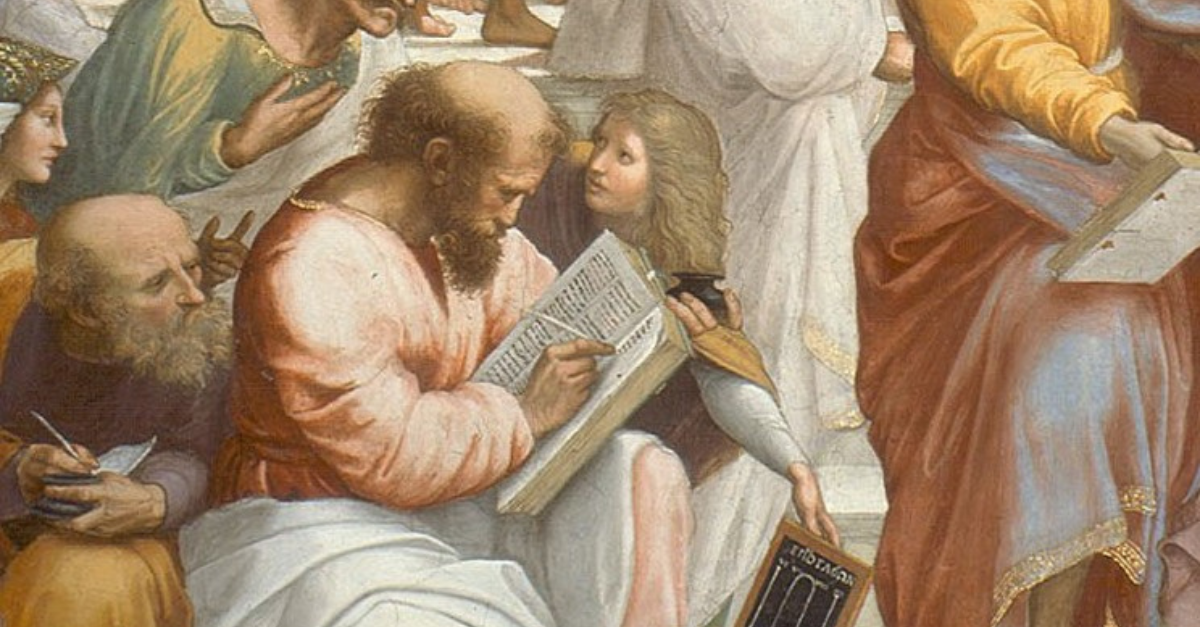
The Meno is read by Ehret on two levels simultaneously. On the surface, it is an inquiry into virtue: Meno offers multiple definitions — a virtue for the master, a virtue for the slave, a virtue for the woman — and Plato, through Socrates, refuses each one. Not because the definitions are wrong in their particulars, but because they mistake the parts for the whole. Plato’s demand is for what ties all the specific virtues together: the unifying quality that makes them all instances of virtue. The dialogue then shifts to the geometric demonstration with Meno’s slave boy — who, through guided questioning alone, arrives at a geometric truth he could not have received by instruction, because he had no instruction to receive. Ehret’s reading is as follows: virtue, like geometric truth, cannot be explained logically. It must be demonstrated. The theme of the painting, as Ehret puts it, is always outside the frame.
3. The Noun-Driven Universe vs. the Verb-Driven Universe
Ehret introduces the first of the contrasts he will develop across the three-part arc of the interview. For Aristotle, the universe is composed of substances — things with fixed natures, definable by their essential properties. Knowledge is the correct categorization of these substances and the deduction of further truths from their definitions. The universe, on this model he argues, is noun-shaped: it is a collection of fixed things to be correctly labeled. For Plato, reality is dynamic. The eternal forms exert an ongoing influence on the changing world of appearances, and the soul is always in motion toward or away from truth. Knowledge is not the correct labeling of fixed things as Aristotelian logic dictates, but an active, ongoing process of discovery. The universe, on Plato’s model, is verb-shaped. Ehret argues that this is the structural difference that determines whether an institution produces genuine discovery or increasingly sophisticated imitation.
Guest Spotlight
Matt Ehret is a Canadian journalist, historian, and lecturer, and a co-founder of the Montreal-based Rising Tide Foundation. He is editor-in-chief of the Canadian Patriot Review and a senior fellow at the American University in Moscow. His work spans intellectual history, geopolitics, and the philosophy of history. He is the author of The Untold History of Canada (four volumes), The Clash of the Two Americas, and Science Unshackled, among other works.
For Further Reading
Primary Sources
Plato. Meno. In Cooper, John M. (ed.), Plato: Complete Works. Hackett, 1997.
✓ CONFIRMED — standard edition
The Meno is the episode’s central text. Ehret reads it as a demonstration that genuine knowledge — of virtue, of geometry, of anything that matters — is always recollection rather than reception. The dialogue’s two movements (the inquiry into virtue and the slave boy demonstration) work together to show what the Platonic method looks like in practice: not instruction but guided questioning, not deposit but awakening.
Plato. Gorgias. In Cooper, John M. (ed.), Plato: Complete Works. Hackett, 1997.
✓ CONFIRMED — standard edition
The Gorgias is the site of Plato’s sharpest engagement with Sophist rhetoric — the tradition that the Academy was explicitly designed to counter. Ehret’s account of the Platonic method gains clarity against the rhetorical alternative: where the Sophist produces persuasion, the Platonist produces discovery. The Sophist fills the vessel; the Platonist lights the flame.
Further Context
For the Academy Arc episodes that provide the scholarly backdrop to this conversation — including Plato’s pedagogical theory, the Academy’s institutional structure, and Aristotle’s departure as the series’ central hinge — see Episodes 8, 9, and 10 of Notions of Progress.
For the Sophist Arc, which establishes the horizontal vs. vertical cumulativity distinction that runs beneath Ehret’s argument — see Episodes 5, 6, and 7.
Questions to Consider Based on This Episode
1. If genuine knowledge is always recollection, what does that imply about the design of educational institutions? Ehret’s reading of the Meno suggests that Plato did not view education as the transfer of information from a knowing teacher to an unknowing student. The teacher’s role, on the Platonic model, is to pose questions that allow the student to discover what they already, in some sense, know. If that model is correct — or even partially correct — it raises a pointed question about the design of modern universities, schools, and professional training programs: are they structured to produce genuine discovery, or to produce the appearance of learning through increasingly sophisticated categorization and memorization?
2. What is the relevance of the distinction between open and closed epistemological systems? Ehret draws a sharp line between the Platonic method — which begins with no fixed assumptions and works toward truth through construction and questioning — and the Aristotelian method, which begins with fixed definitions and proceeds deductively. Critics of this framing might argue that Aristotle’s logic has itself been a tool of genuine discovery, not merely of sophisticated categorization, and that Plato’s dialogues are not free of their own fixed commitments.
3. What does the Meno’s slave boy demonstration actually prove? Ehret, as other Platonic scholars, reads the Meno’s slave boy sequence as a demonstration that genuine understanding is always recollection — that the capacity for mathematical truth was latent in an uneducated slave, and that what Socrates provided was not information but the conditions in which discovery could occur. Skeptical readers have long questioned this interpretation: does the demonstration show that knowledge is innate, or does it show that skilled questioning can produce the appearance of discovery? Sitting with the question is part of what the Meno is designed to produce.
4. What does it mean that Aristotle defended slavery while the Platonic tradition, as Ehret reads it, generated an anti-slavery movement? Ehret notes that Aristotle explicitly defended slavery as the natural order — arguing that certain people are born to be ruled and others to rule — and that he had to contend with what he described as ‘misbegotten philosophers’ who believed slavery was unnatural. If the Meno’s slave boy demonstration — showing that an uneducated slave possessed the latent capacity for geometric truth — was a potent argument against the naturalness of slavery, then the Platonic method was not merely an epistemological position. It had profound consequences. Whether those consequences were intended by Plato, or emerged from the logic of his method, is a question the episode leaves open.
Connecting the Dots
The Academy Arc — Episodes 8, 9, and 10 — established a specific question: whether Plato invented a theory of cumulative philosophical progress and whether it held through the Academy’s first succession. Episode 10 closed by identifying Aristotle’s departure as the founding bet’s first test, and leaving the verdict open. Episode 11 picks up that open verdict and engages a guest who answers it from inside the Platonic tradition.
Ehret’s argument does not contradict the Academy Arc’s conclusions from previous episodes — it extends them into territory the solo episodes could not reach. Where the Academy Arc asked whether vertical cumulativity of knowledge was Plato’s invention and whether it survived Aristotle’s departure, Ehret asks what it would mean for Western intellectual history if it did not survive — if the Aristotelian tradition, not the Platonic, had governed the major institutions of the West. That is the question Episodes 12 and 13 will press. The civilizational stakes Ehret identifies — Renaissance humanism, the American founding, the fate of the scientific method — will be the subject of the arc’s remaining two installments.
For listeners coming to the Plato–Aristotle divide fresh: Episodes 8 through 10 provide the scholarly foundation. For listeners who want to pursue Plato’s Meno directly: the Hackett Complete Works edition is the standard starting point. For the Sophist Arc that establishes what Plato was responding to: Episodes 5, 6, and 7.
Connection to Notions of Progress
This episode introduces a different register to the series. Ehret argues from within the Platonic tradition — he is not analyzing it from outside but making a case for it as a living civilizational program. That is precisely the kind of voice this episode format is designed to surface: thinkers who press the question of progress from inside a tradition they believe drives it. Whether Ehret’s reading of the Plato–Aristotle divide holds across the full sweep of Western history is a question Episodes 12 and 13 will continue to develop.
Two Depressions, One Cause? Michael Roberts on 1873, 1929, and the Rate of Profit