Two Depressions, One Cause? Michael Roberts on 1873, 1929, and the Rate of Profit
Does a falling rate of profit cause a slump, or does it only show up at the end of one? Asked that question in Part Two, Michael Roberts says it is exactly the objection raised against Marx’s law of the tendency of the rate of profit to fall. His answer is that the order runs from profitability to investment: when profits fall, investment falls, and a slump follows, a sequence he says can be shown empirically. He adds that economists on the left dispute the law too, and that some Marxists have offered alternatives. The argument reaches the present through AI, where Roberts says profitability, if it existed, would erode as every firm adopted the technology.
Overview
In Part Two of a three-part conversation, Michael Roberts takes the claim from Part One back to the depressions of the 1870s and the 1930s. He answers the Austrian-school and gold-standard accounts of the 1870s, sets out the mechanism he draws from the third volume of Marx’s Capital, and describes the stock-market euphoria that, on his account, ran above falling profitability in the late 1920s. The conversation closes on four rival explanations of slumps and his reasons for placing profit beneath all of them.
Key Moments from the Conversation
Was There an 1870s Depression?
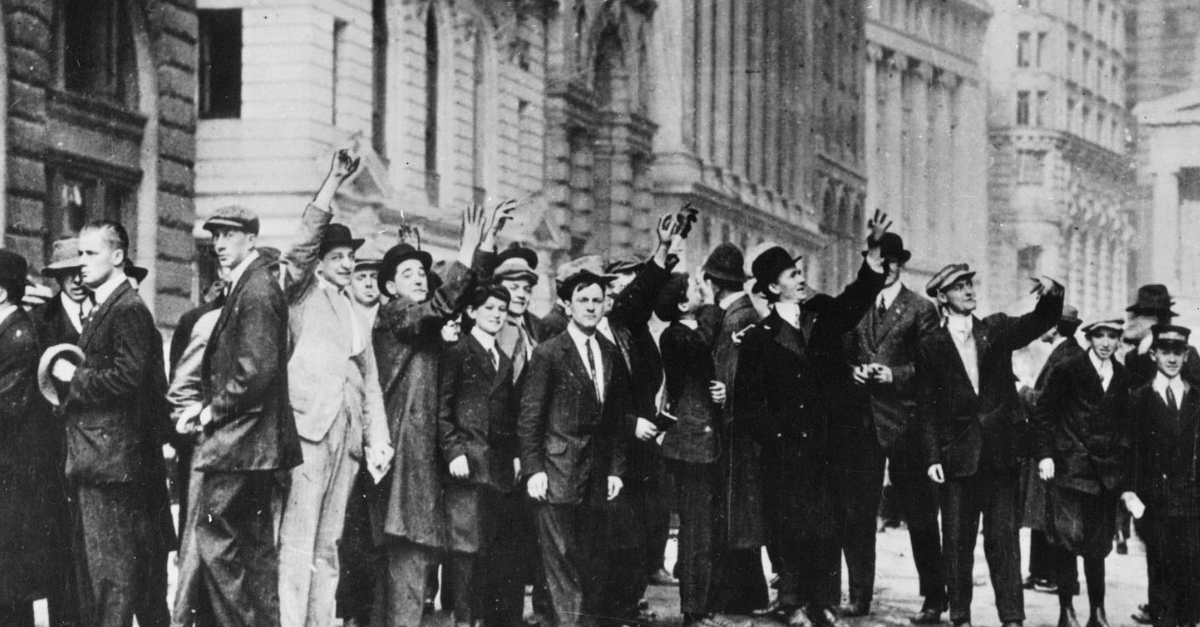
Roberts reports two objections to calling the 1870s a depression. The Austrian school, he says, denied that one occurred and attributed any decline to excessive earlier debt. A second account grants the slump but assigns a monetary cause: gold, as international money, grew scarce under the gold standard. Roberts replies that contemporaries in the 1870s were convinced a depression was under way, and that the data for Britain, then the leading economy, show a lower growth trend than in the previous period. He says scholars have documented this in detail and that he cites them in the book.
Why Profitability Falls
Roberts describes the mechanism he takes from Marx’s Capital, Volume 3. Capitalists invest only when it is profitable, and competition pushes them to put more into machinery relative to labor, which Marx called the organic composition of capital. In Roberts’s account of Marx’s value theory, machines help workers create value but produce none themselves, so a rising share of machinery pulls the rate of profit down. Marx also listed counteracting factors, including more workers, longer hours, cheaper machinery, and profit from foreign trade. Roberts says each has limits.
1929 and the Rival Theories
For the late 1920s, Roberts says profitability was falling in the United States and Europe while a stock market fueled by heavy borrowing kept rising, and that mainstream economists of the time expected no collapse. He then reviews four rival explanations: policy errors, out-of-control finance, underconsumption, and overproduction. Citing Engels, he says workers have never had wages enough to buy all output, so underconsumption cannot explain why booms end, and most sales run between capitalists. Overproduction, he says, describes a slump without explaining why booms turn. He returns to profit as the factor beneath each.
Guest Spotlight
Michael Roberts worked in the City of London as an economist for over 30 years before retiring. He is the author of several books: The Great Recession: A Marxist View (2009); The Long Depression (2016), the book at the center of this conversation; World in Crisis (joint editor, 2018); Marx 200: His Economics (2018); and Engels 200: His Economics (2020). With Guglielmo Carchedi, he co-authored Capitalism in the 21st Century (2023). His new book, Time Is Running Out: The World Economy in the 2020s and Beyond, is forthcoming in December 2026. He writes regularly at thenextrecession.wordpress.com.
For Further Reading
Primary Source
Michael Roberts, The Long Depression (2016) — the book at the center of this conversation. Chapters 1 through 3 (“The Cause of Depressions”; “The Long Depression of the Late Nineteenth Century”; “The Great Depression of the Mid-Twentieth Century”) are titled for the questions and cases Roberts discusses in this episode.
Questions to Consider
1. Roberts holds that falling profitability drives investment down, and says the evidence shows it. What evidence would separate a cause from an effect when both move together in a slump?
2. Roberts notes that some Marxist economists dispute the law and offer alternatives. How should a listener weigh a disagreement among scholars who share a framework?
3. Roberts answers the claim that no depression occurred with data, and the gold-standard account with profitability as the cause. Can whether an episode happened and why it happened be tested separately?
Connection to Notions of Progress
Roberts presents a mechanism that ties capitalism’s dynamism to its crises: competition drives investment in machinery, which he credits with raising productivity, and the same process, in his account, pulls the rate of profit down until slumps follow. For a series that asks what drives progress, this places the engine and the interruption in one cause. Economists across the spectrum, he acknowledges, disagree about which cause lies beneath a slump, which leaves the question open. Part Three brings his argument into the present.
Listen & Subscribe
Website — notionsofprogress.com
Email: marshall@notionsofprogress.com
A Marxist in the City of London: Michael Roberts on The Long Depression